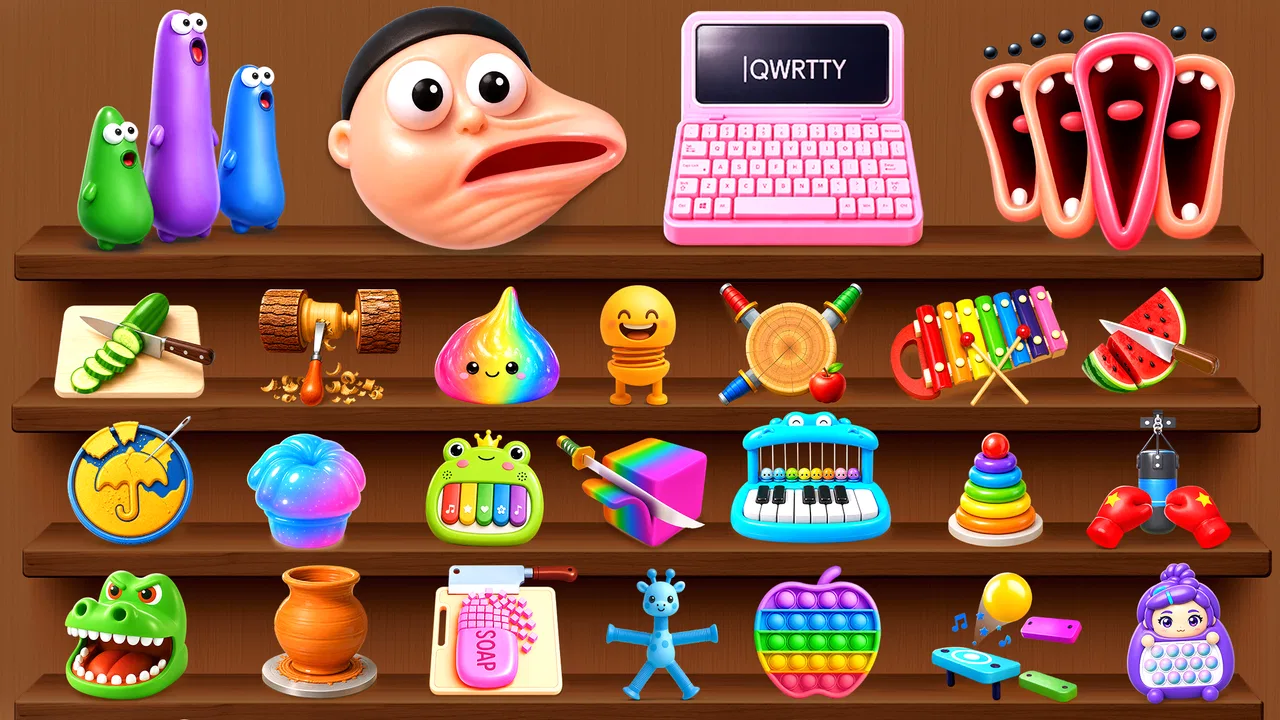
Satisfying Toys : Calm Games
- 4.6
- Rating
- 10.00M
- Installs
- Free
- Price

 Analysis by App-foxy
Satisfying Toys: Calm Games is the kind of casual game I open when I want a small break rather than a serious challenge. Its focus is simple: short antistress activities, gentle audio, and tactile interactions that are meant to help me slow down. I would not describe it as a deep game with a long-term mastery curve. I see it more as a pocketful of calming distractions for those moments when my attention is scattered and I want something easy to do with one hand.
That narrow purpose is also its biggest strength. Many casual games try to keep me playing through scores, competition, missions, or increasingly difficult stages. This one aims for a softer experience. Created by Koko Zone, it belongs to the casual games category and is free to start, with optional in-app purchases ranging from $0.99 to $9.99 per item. The game is rated for Everyone, so its presentation is approachable for a broad audience, including younger players with suitable supervision around purchases.
Why the small, calming format works
In my experience, the best way to use this game is not to treat it like a title I need to finish. I open it before bed, during a short pause between tasks, or when I notice myself repeatedly checking the same apps without actually relaxing. The mini-game structure makes that easy because I can interact for a little while without committing to a long session.
You May Also Like

 Google Keep - Notes and lists
Google Keep’s Quiet Growth Shows the Appeal of Simpler Notes
As mobile work gets busier, Google Keep keeps winning a simple contest: capture a thought quickly, find it later, and get on with the day.

 Blood Strike: 2.5 Anniversary
Blood Strike’s Loadouts Turn Every Drop Into a Tactical Gamble
A close look at Blood Strike’s custom loadouts: how fast access to signature weapons reshapes its battle royale rhythm, rewards preparation, and narrows the gap between fights.

 Pandora - Music & Podcasts
Pandora’s Music Is Easy to Start, but Harder to Recover
Pandora’s strength is its low-effort path from a seed to a station. Its weak spot is how much confidence it asks you to place in connection, setup, and quiet recovery.

 8 Ball Pool
 Is Built on Rivalries, Rematches, and Routine
A close look at the rivalries, rematches, shared routines, and unanswered safety questions that turn a quick pool match into a persistent mobile community.

 Samsung Music
’s Quiet Strength Is Playing What You Already Own
Its reach comes less from spectacle than from dependable access to a personal library. That simplicity is both the app’s strongest retention engine and its ceiling.

 AccuWeather: Weather Radar
AccuWeather Review: A Quick, Clear Forecast for Everyday Decisions
For everyday plans, the best forecast is the one you can understand quickly. AccuWeather makes rain timing, radar, and local conditions easy to act on, with a few trade-offs.
More From Our News Desk



The central appeal comes from the combination of simple play and relaxing sounds. That pairing matters more than it may seem. A repetitive visual action can become irritating if the audio is harsh or overly energetic, while pleasant sound alone can feel passive. Here, the two elements are designed to work together, creating a low-pressure activity that gives my hands and attention something gentle to do.
I found that this makes the game particularly suitable for transition moments. After finishing work, I may not be ready to concentrate on a book or a demanding game, but I also do not want to jump straight into social media. A short session gives me a deliberate pause. The game does not solve stress, of course, but it can interrupt the habit of filling every quiet second with more stimulation.
The important distinction is that this is a relaxation tool with game-like interaction, not a conventional game built around achievement. If I judge it by depth, challenge, or progression, it feels limited. If I judge it by how quickly it lets me settle into a quiet routine, its design makes more sense.
What I pay attention to during play
When I use a collection of mini games like this, I look for three things: whether the controls feel immediately understandable, whether the activities remain pleasant after the novelty fades, and whether the app respects the mood it is trying to create. Satisfying Toys: Calm Games is strongest in the first and third areas. It is easy to approach, and its calm identity is clear from the beginning.
There is no need for me to learn a complicated control scheme before getting started. That makes it a good choice when I am mentally tired. I can pick it up without first reading instructions or studying a large interface. This also helps children and less experienced mobile players, although the Everyone rating should not be mistaken for a guarantee that every session is equally suitable for every child.
The sound design is another part I would not ignore. I usually keep the volume low, especially in public or at night, but the audio still contributes to the sense of rhythm. For the most relaxing result, I use the game in a quiet place rather than alongside a loud video or busy conversation. When the environment is already noisy, the calming effect becomes much less noticeable.
A useful personal trick is to decide on a stopping point before opening it. Because the activities are intentionally easy to return to, I can otherwise keep tapping simply because nothing tells me that the session has naturally ended. I prefer using it for a short reset, then putting the phone down. That turns the game into a small routine instead of another source of endless screen time.
A realistic everyday use case
Imagine coming home after a crowded commute. I may feel too restless to sit quietly, but too drained to play a competitive game. In that situation, I can open this title, lower the sound, and spend a few minutes with the simple interactions. The point is not to win anything. The point is to give my attention a harmless landing place while I change clothes, wait for dinner, or let the day separate from the evening.
Another useful moment is before a difficult task. If I am stuck on a piece of writing or preparing for a meeting, taking a short break with something calm can be better than opening an app full of alerts. I would keep the session brief, then return to the task with a clearer boundary around the break. This is one of the more practical ways to use the game: not as a replacement for rest, but as a controlled interruption when my mind is overactive.
I can also see it working for people who fidget while listening. During an audio lesson, phone call, or quiet waiting period, a simple tactile activity may be more comfortable than repeatedly switching between unrelated apps. That said, I would avoid using it during situations that require full attention. Its relaxing purpose does not make it appropriate while driving, crossing roads, or handling anything that needs concentration.
Where it compares well with other casual games
The usual alternatives in the casual category often depend on puzzles, quick reactions, matching, collecting, or score chasing. Those formats can be more satisfying when I want a goal. They give me a reason to improve and often provide clearer progress. Satisfying Toys: Calm Games takes the opposite route. It is better when I want low stakes and worse when I want a challenge that keeps developing.
Compared with a puzzle game, this title asks less from my working memory. I do not need to plan several moves ahead or worry about losing a good run. Compared with an action game, it is less demanding on reflexes and less likely to raise my energy. Compared with a meditation app, it gives my hands something to do instead of asking me to remain still and follow a guided exercise. That middle position is its most distinctive practical advantage.
However, someone looking for structured mindfulness may prefer a dedicated meditation app. A meditation app is usually more suitable when I want breathing guidance, timed sessions, or a deliberate mental exercise. Someone looking for a satisfying progression loop may prefer a puzzle or idle game. This title sits between those choices, offering a light interactive pause without promising a complete wellness program or a substantial campaign.
The limitation that matters most
The same simplicity that makes the game accessible can also make it feel thin. I can enjoy the first few sessions because the interactions are fresh, but the long-term appeal depends heavily on whether I personally like repeating calming actions. Players who need new objectives, unlockable systems, or a strong sense of advancement may run out of reasons to return.
That is not a flaw I would hide behind the word “relaxing.” Calm design still needs to respect the player’s time. If I open a game expecting meaningful progression, I may feel that the experience is too slight. The right expectation is closer to a digital fidget break than to a full casual adventure. Once I accept that, the limited ambition becomes easier to appreciate.
The free-to-play structure is another point worth considering. The game can be downloaded without an upfront charge, but optional purchases are present. I would be careful with this if a child is using the device, particularly because a calming game can feel harmless enough to hand over without much thought. I recommend checking the device’s purchase controls and making sure the person playing understands that free access and optional paid items are different things.
I also would not rely on it as a treatment for serious anxiety, persistent stress, or sleep problems. It may help me take a brief mental pause, but that is a modest benefit. If stress is affecting daily life, a casual game should be only a small part of a broader approach. Its value is in the moment-to-moment experience, not in making medical or therapeutic claims.
Who will get the most from it
I would recommend this game to people who enjoy tactile mobile activities but do not want pressure. It is a good fit for someone who likes opening a phone game for a few minutes, prefers soft audio to loud effects, and is happy without leaderboards or demanding objectives. It may also suit families looking for an approachable casual title, provided adults manage purchase settings and choose appropriate playing situations.
It is especially useful for players who find traditional meditation difficult because sitting still leaves them more distracted. The light interaction can act as a bridge toward a quieter state. I would not call it meditation, but the physical focus may be more accessible for some people than a silent timer.
On the other hand, I would skip it if I mainly play to improve, compete, collect rewards, or uncover a story. It is also not my first choice when I want a game that can occupy a long journey with substantial variety. A puzzle title, rhythm game, or story-driven casual game would offer more reasons to keep playing over an extended period.
Device requirements are fairly approachable: the current version is 0.6.5 and it supports Android 7.0 or later. That makes it relevant for people using older compatible Android devices rather than only recent phones. The game has also reached over ten million installs and carries a 4.7 average from around sixteen thousand ratings, which suggests that its straightforward concept has connected with a sizable audience. I treat those figures as useful context, not as a substitute for deciding whether this particular style suits me.
Small habits that improve the experience
I get more from the game when I use it intentionally. First, I choose a quiet audio level instead of turning the sound up. The relaxing quality is easier to notice when the effects blend into the background rather than competing with everything around me. If I am in a noisy place, I would rather use headphones at a comfortable volume or wait until I can hear the game properly.
Second, I use it as a boundary between activities. Opening it immediately after a stressful task and deciding that the session will last only until I feel ready to move on gives the interaction a purpose. Without that boundary, even a calm game can become another automatic scrolling habit.
Third, I pay attention to which kinds of interactions actually settle me. Not every mini-game will appeal equally to every player. I would return to the ones that feel smooth and leave the others alone rather than forcing myself to use the entire collection. This is a more useful approach than trying to extract maximum content from a title designed around casual experimentation.
Finally, I keep expectations realistic. If I am tired, irritated, or anxious, the game may make the next few minutes easier, but it will not erase the reason I feel that way. I see it as a reset button, not a solution. That distinction helps me enjoy its strengths without asking it to do a job it was never built to do.
My verdict after looking at the whole package
Satisfying Toys: Calm Games succeeds because it understands its lane. Koko Zone has made a casual game for brief, low-pressure interaction, and the relaxing sound design supports that purpose. I like that I can open it without preparing for a challenge, follow the simple activities, and close it when I feel ready. For a free game aimed at small moments of calm, that directness is more valuable than unnecessary complexity.
Its weaknesses are equally clear. The experience may not hold my attention for long sessions, and players who want progression or competition will probably find it underpowered. Optional purchases also mean I would set sensible controls before letting a child use it. Those are not reasons to dismiss the game; they are reasons to choose it for the right situation.
Overall, I recommend it to anyone seeking a gentle alternative to noisy, goal-heavy mobile games. I would install it for short breaks, waiting rooms, evening decompression, or those moments when my hands need something simple to do. I would skip it if I wanted a substantial game to master. Used as a small calming companion rather than a complete entertainment system, it earns its place on my phone.
FAQs for Satisfying Toys : Calm Games
01What is Satisfying Toys: Calm Games all about?
Satisfying Toys: Calm Games is designed to provide users with a relaxing and stress-relieving experience through a variety of interactive toys and games. These activities are crafted to engage your senses and offer a peaceful escape from daily stress, making it an ideal app for unwinding after a long day.
02Is Satisfying Toys: Calm Games suitable for all ages?
Yes, Satisfying Toys: Calm Games is suitable for users of all ages. The app features simple and intuitive gameplay that can be enjoyed by children and adults alike. It's a great tool for helping kids develop fine motor skills and for adults seeking a moment of calm and relaxation.
03Does Satisfying Toys: Calm Games require an internet connection?
No, Satisfying Toys: Calm Games does not require an internet connection to play. Once downloaded, all the toys and games are available offline, making it convenient for users to access the calming content anytime, anywhere, without worrying about connectivity issues.
04Are there any in-app purchases in Satisfying Toys: Calm Games?
Yes, Satisfying Toys: Calm Games offers in-app purchases. While the app is free to download and includes a variety of toys, additional features and premium content can be unlocked through optional purchases. This allows users to enhance their experience with more diverse and engaging activities.
05What devices are compatible with Satisfying Toys: Calm Games?
Satisfying Toys: Calm Games is available for both Android and iOS devices. It supports a wide range of smartphones and tablets, ensuring that users can enjoy the app's calming features across different platforms. Make sure your device meets the minimum system requirements for optimal performance.
Pros
- Wide variety of relaxing games.
- Intuitive and user-friendly interface.
- No intrusive ads interrupting play.
- Regular updates with new content.
- Supports offline play.
Cons
- Limited customization options.
- Some games are repetitive.
- In-app purchases can be pricey.
- No multiplayer mode available.
- Occasional lag on older devices.

Satisfying Toys : Calm Games
Gallery